Industrial Productivity Platform
A live model of how your equipment, lines, incidents and documents actually relate. Every capability reads from it, so nothing reasons from a corner of the picture.
Problem
Most manufacturers don't have an AI problem. They have a data-context problem. The usual answer is to add more AI agents, but an agent can only reason over what it can see. If it sees one silo, it inherits that silo's blindness. Deploy more of them and you scale the blind spots, not the intelligence.

Agent

Maintenance
Agent

Quality
Agent

Production
Agent

Documents
Four agents, four blind spots. None can see across the wall.
Architecture
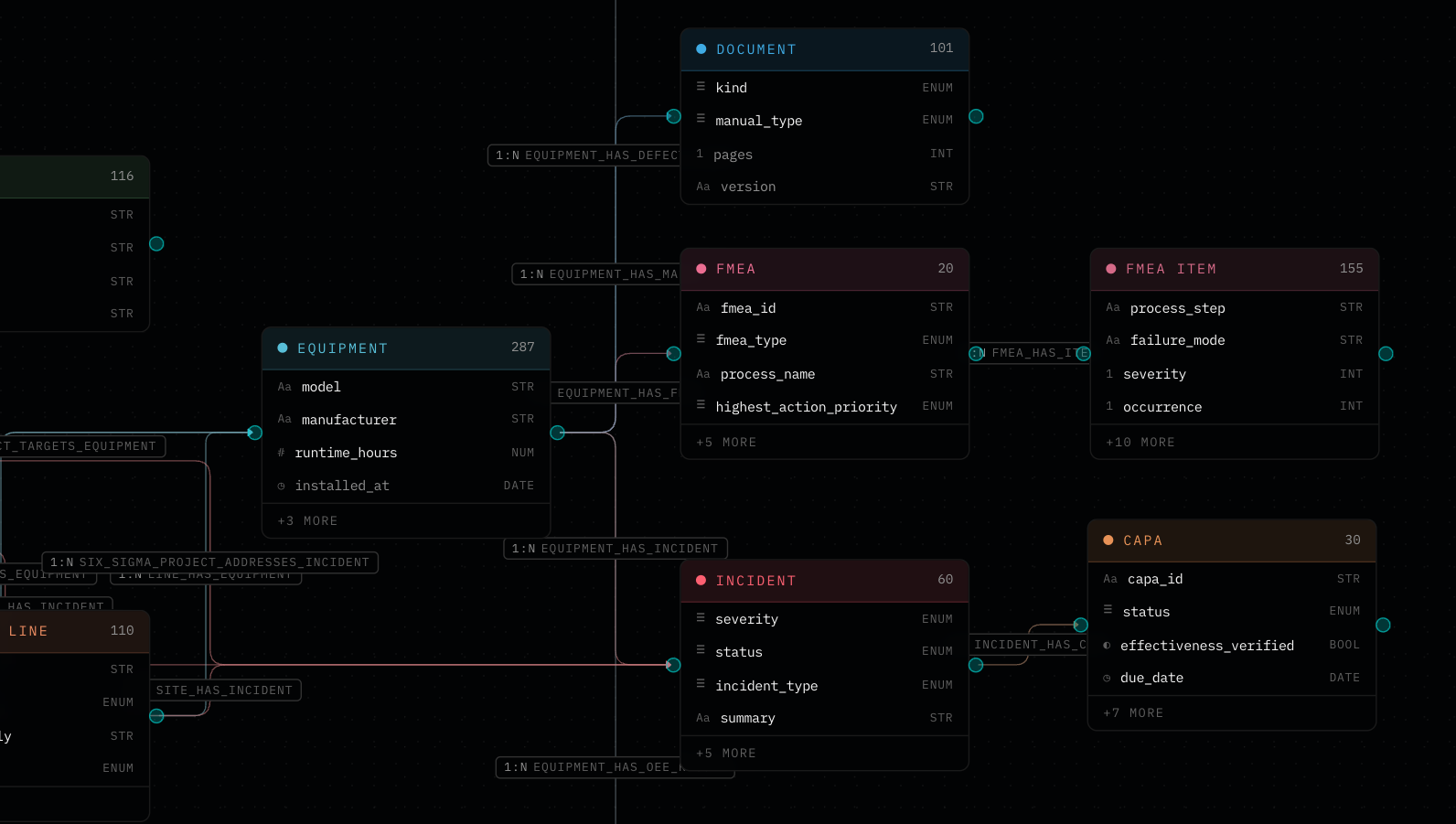
A data lake puts everything in one place. It doesn't make the pieces understand each other. Two engines do that harder work: one builds a living model of your operation, one puts it to work.
The Transform Engine
Parses manuals, SOPs, FMEAs, event logs, machine signals and more, then maps them to entities: machines, process steps, failure modes, causes, corrective actions. When domain knowledge is needed, it asks your engineers and writes the answer into the model.
The knowledge model
Your operation as connected entities and relationships, in your vocabulary rather than ours. Stable process knowledge and live production events in one place, and easy to update as the operation changes.
The Orchestration Engine
Assembles the exact slice of the model a task needs: upstream steps, propagation paths, comparable history. Answers come back with sources and a confidence signal. Deterministic pipelines do the heavy lifting; agents reason only where reasoning earns it.
In your landscape
No rip-and-replace. Data flows from the systems you already have into one governed model, and back out as answers, spanning the OT and IT divide that keeps them siloed. If it has an interface, we can read from it.
Your systems
SCADA
PLC / Historians
MES
ERP
PLM
Quality & docs
›

Transform Engine
Parses and maps your data to entities
›

One knowledge base
Your operational memory
›

Orchestration Engine
Assembles context, returns answers with sources
›
Capabilities
Predict & Prevent
Operate
Simulate

Governance
Versioned
Approved sources
Access control
Audit history
Modules
Every module inherits the entire knowledge base instead of rebuilding its own pipeline. Start with one. Each module you add makes the others smarter.


The future
Predict & Prevent
Surface risk before it becomes downtime.
Root-cause analysis
Predictive maintenance
and more…

The present
Operate
Run the floor on a live, shared picture of what’s happening now.
Daily management
Operator support
and more…

The hypothetical
Simulate
Test a change against a model of your operation before you commit.
Line balancing
WIP simulation
and more…
Every module answers the same way: grounded in your data, scored for confidence, specific enough to act on. Here, a root-cause investigation that turns into prevention.
Example · Root-cause analysis

“Batch 1234 failed due to etch-pressure drift at Step 47, Chamber 2. Confidence: high. Evidence chain attached.”

“47 in-flight batches passed the same step under the same conditions. Flagged for review before final test.”
Trust & compliance
The questions your IT and OT security teams will ask, answered before they ask them.
SOC 2 Type II
Independently audited controls for security, availability and confidentiality. The evidence your compliance team asks for.

Cloud or hybrid
Run it fully managed, or keep sensitive operational data on-site with a hybrid deployment. Your data residency, your call.

Read-only by default
The platform reads from your control systems. It does not write back to them. No new path into your OT environment.

Governed knowledge
Versioning, approval status and access control on every source. Answers come from approved, current documentation.

Auditable by design
Every answer traces to the signal or document behind it. Full lineage, on demand.

Knows when it doesn't know
Thin evidence or a novel pattern gets flagged, never papered over with a guess.
New capabilities ship to the knowledge base and every module. See what's new →
Where do I start?
A short digital assessment maps your systems and data against what the platform can do, and shows where you'd see value first. Want the full picture? We visit your floor and leave you with a 12-month roadmap.

 Log in
